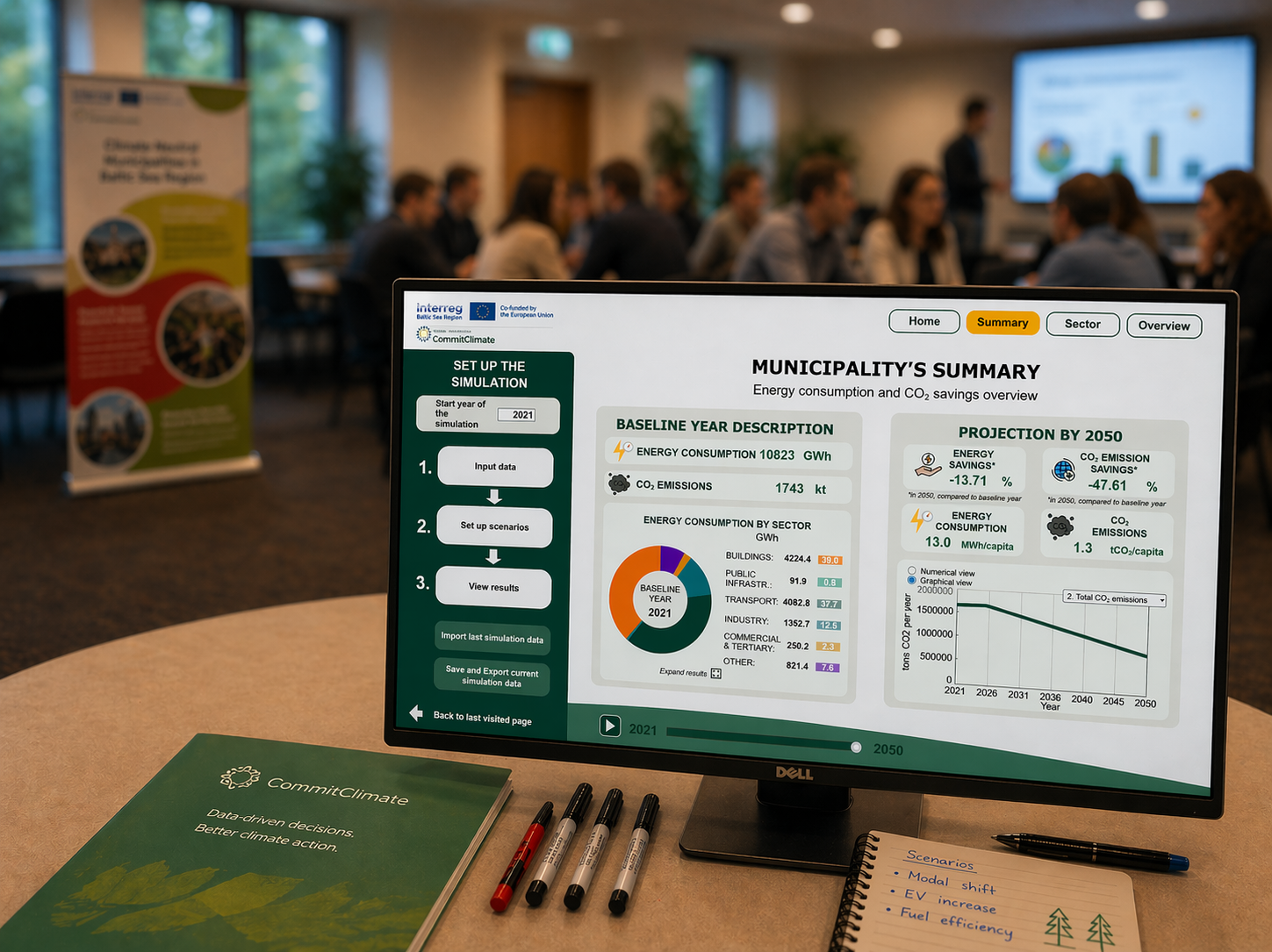
Born from cross-border European cooperation, CommitClimate gives municipalities a free tool to simulate emissions, test policy scenarios, and build credible, data-driven climate action plans.
THE MISSING LINK IN MUNICIPAL CLIMATE ACTION
Across Europe, municipalities are expected to lead the transition to climate neutrality, yet many still make decisions based on assumptions rather than evidence. Without reliable data on their own emissions or the real impact of different policy choices, climate action plans risk being ambitious on paper but ineffective in practice. CommitClimate, led by Riga Technical University's Institute of Energy Systems and Environment with partners from Latvia, Sweden, Estonia, and Poland, was built to close this gap. Made possible through the EU-funded Interreg Baltic Sea Region Programme, it is a direct product of European cooperation: a shared, practical solution to a challenge no single country could solve alone.
A FREE SIMULATION TOOL BUILT FOR LOCAL GOVERNMENTS
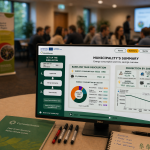
At the heart of CommitClimate is a free, open-access CO2 simulator tailored specifically to local governments. Municipalities can calculate emissions across buildings, transport, energy, and waste, and test the impact of different policy choices before committing to them. Unlike many existing tools, it requires no extensive data or external expertise, making it accessible to municipalities of all sizes and capacities. The platform combines transparent emissions modelling with practical guidance and citizen communication tools, shifting climate planning from static reporting to a dynamic, evidence-based, and inclusive process.
FROM BALTIC COOPERATION TO EUROPE-WIDE IMPACT
In municipalities such as Cēsis in Latvia and Pałecznica and Raciechowice in Poland, CommitClimate is already supporting the development of more realistic and transparent climate action plans. By allowing local governments to test and compare policy scenarios, it improves decision quality and helps prioritise effective measures. Its transferable approach works across municipalities with varying data availability, supporting wider uptake across Europe. By making climate decisions more transparent, it also strengthens communication with citizens and builds public trust in local climate action, turning European climate ambition into informed, measurable, and inclusive results.