Budapest's Districts II and VI hosted the world's first women-only citizens' assemblies in 2025, producing binding policy recommendations and a permanent Women's Council.
WOMEN RECLAIMING THEIR PLACE IN LOCAL DEMOCRACY
Women are often the main bridge between families and public services, managing daily interactions with healthcare, education, and social systems. Yet they remain largely absent from the spaces where decisions about these services are made. Cultural norms, time constraints, and institutional barriers continue to limit their political participation across Hungary and Central and Eastern Europe. In autumn 2025, DemNet partnered with Budapest's District II and District VI to confront this directly — designing and implementing what became the world's first women-only citizens' assemblies.
FIVE DAYS THAT CHANGED TWO DISTRICTS
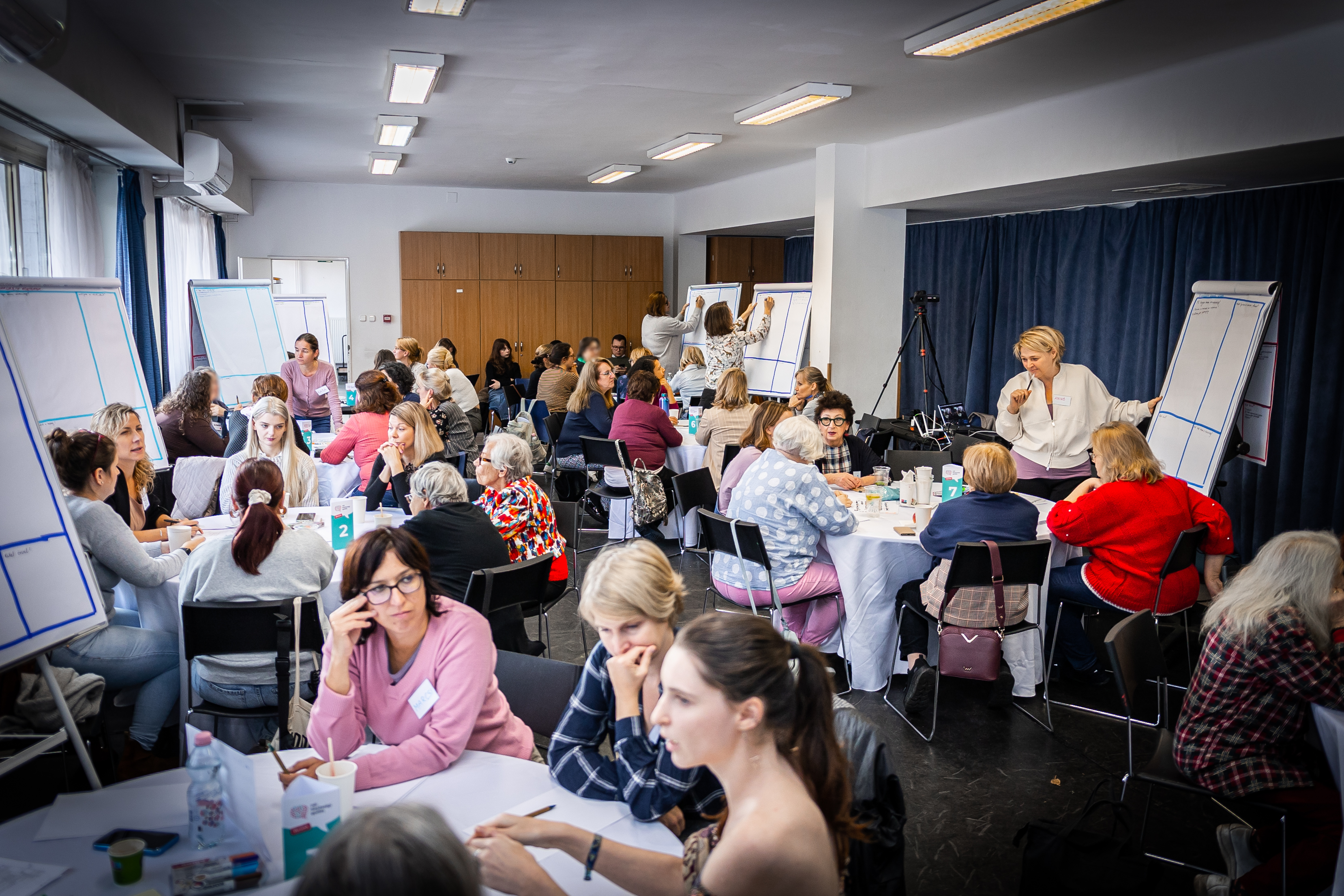
In each district, 46 demographically representative women were selected through civic lottery from more than 600 applicants. Over five full days, participants engaged with diverse experts and stakeholders, deliberated in professionally facilitated small groups, and developed concrete policy recommendations on local public services, urban life, and safety for women. The process followed strict international deliberative standards set by the OECD and Council of Europe, including random selection, balanced information, and independent facilitation. For many participants, it was their first time engaging in public affairs.
THE ASSEMBLY ENDED. THE WOMEN'S COUNCIL CONTINUES.
The assemblies' most important impact lies in what followed. In February 2026, District II's Municipal Council formally adopted the assembly's recommendations as guiding principles for future urban development and municipal services. It also passed a decree establishing a permanent Women's Council, composed of randomly selected female residents, creating a continuous channel for participation and future deliberative processes. This is a first in Central and Eastern Europe: a shift from one-off participation to embedded, institutionalised democratic practice that strengthens accountability, trust, and democratic legitimacy for the long term.